When people hear the phrase ‘Bloody Barnes’, they may now think of the crime writing festival launched this February, which brought the likes of Mark Billingham, Sophie Hannah, Vaseem Khan, Martin Edwards and Frank Gardner to Barnes. But before the festival arrived, ‘Bloody Barnes’ was the sort of phrase you might hear coming from the lips of those exasperated by the quirks of life in this leafy, and largely very peaceful, corner of South West London. One such person is my fictional detective, DI Garibaldi, and at the inaugural Bloody Barnes Crime Writing Festival I had the pleasure of discussing both him and his relationship with Barnes, the setting for all five Garibaldi novels.
I began the talk by recalling something Colin Dexter once told me in an interview. He admitted that when he started the Inspector Morse novels he did very little research into police procedure. In fact, he made most of it up. What he concentrated on instead was character and place. Morse and Oxford, he believed, were what readers would remember long after the mechanics of detection had faded. He was right. We may forget the finer details of individual plots, but we do not forget Morse’s melancholy intelligence, nor the spires and college quads that framed his investigations.
To illustrate this at Bloody Barnes, I gave the audience a quick-fire quiz. I called out the names of fictional detectives; they responded with the locations. Rebus—Edinburgh. Maigret—Paris. Miss Marple—St Mary Mead. Sherlock Holmes—London. Bergerac—Jersey. The answers came instantly. When I added DI Garibaldi to the list, the response was gratifyingly immediate: Barnes.
Character and place are undoubtedly the most important elements in the Garibaldi novels, and in the genesis of the series it was character – or rather the name of a character – that came first. During my wife’s research into her family history, she discovered an ancestor in a very English family who bore the middle names Giuseppe Garibaldi. Further investigation unearthed the reason. Apparently the Italian revolutionary was a figure of near cult-like adoration in Victorian England—so much so that some people named their children after him.
Something about the name struck a chord with me. And so I decided to give it to my detective, amused that it might remind readers as much of the currant-filled biscuits as of the hero of Italian unification. I gave DI Garibaldi a few of my own characteristics—Irish-Italian ancestry, an inability to drive, a love of books and country music, possession of a QPR season ticket—and then looked for a home for him.
It didn’t take long to fix on Barnes. The lazy part of me suggested that, having lived there for over thirty years, I wouldn’t have to do much research. But there are other things about Barnes that make it a good setting for a crime series. It sits within a loop of the Thames, almost enclosed by water and can feel cut off from the rest of London—a sense of isolation accentuated by the long-term closure of Hammersmith Bridge to traffic.
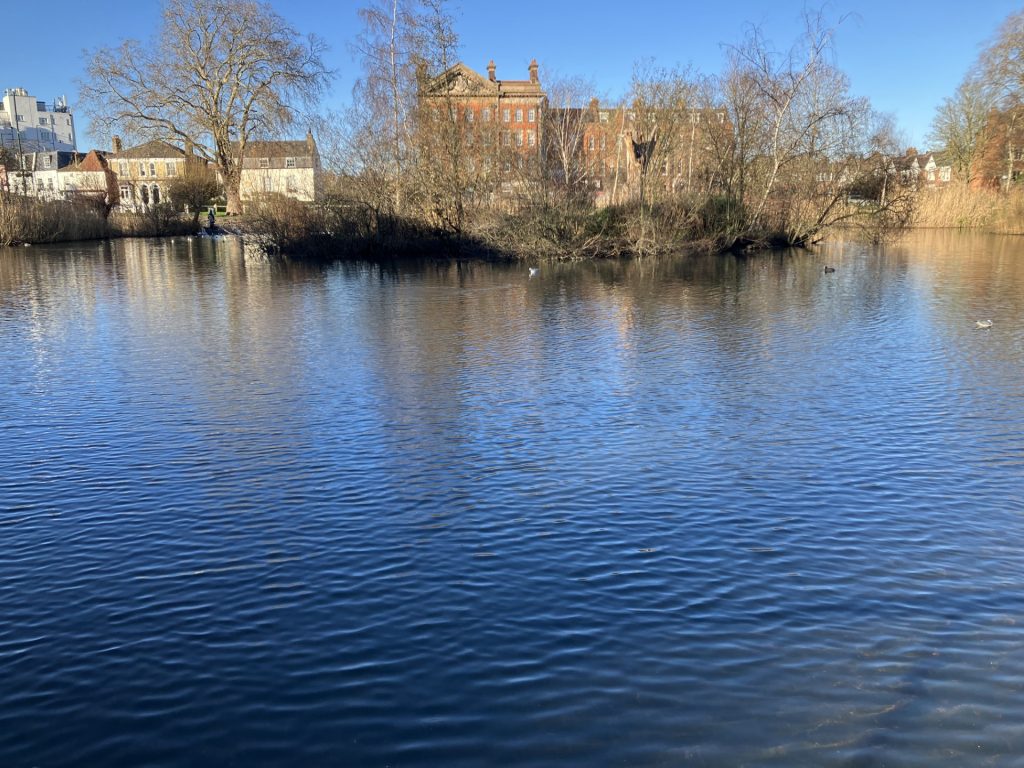
The area has a village feel. The Green, the Pond, and the picture-postcard pubs make you feel not only that you’re not in London at all, but also that you’ve stepped back into a gentler, more innocent time. This is where I chose to put DI Garibaldi but I decided to make him at odds with the place. He’s not entirely comfortable in his surroundings, particularly the affluence and occasional arrogance of some if its inhabitants. He rails against ‘the Barnes self-confidence that borders on smugness’ taking potshots at types ranging from the green-welly-wearing dog-walkers to the young bankers and lawyers pushing over-large buggies and talking in loud ‘weekend-dad’ voices on Saturday mornings.
My talk was titled ‘What Lurks Beneath’ suggesting, in the best traditions of crime fiction, that appearances can be deceptive, and that dark passions can be found in the most innocent-looking places. As Garibaldi says to his boss: ‘It can all seem a bit Jane Austen, but scratch the surface and you’ll find it’s really a bit Emily Brontë’. In the Garibaldi books murder victims are found in the most peaceful places—a nature reserve, a secluded cemetery, or the reeds of the village pond. In the latest book, ‘The Carousel of Time’, the victim is found right in the middle of the Barnes Fair carousel, turning a symbol of childhood joy into a grim crime scene.
During the festival talk, I asked the audience for suggestions for where in Barnes the next murder victim might be found. They responded with unsettling enthusiasm, identifying potential darkness in the most innocent locations (the allotments, for some reason, proved very popular).
The emergence of a crime writing festival in the heart of Barnes is entirely in keeping with the spirit of the novels. Billed as ‘Murder on the Green’, the festival’s aim was to bring mystery and mayhem to the ‘gentlefolk of Barnes’. In the fifteen events over the weekend crime fiction was explored in all its varieties and from a range of angles. The weekend also marked the first award of The Cob & Pen, a prize for the best crime novel of the year, presented at a gala dinner to Mark Ellis for his novel ‘ Death of an Officer’. The name of the award, to be made each year, is not only a nod to the swans on Barnes Pond but also a tribute to the writer’s craft.
Colin Dexter was right. Long after the details of the cases fade, it is the sense of character and place that remains. Garibaldi may gripe about the “smugness” of the village, but he remains rooted there—in this leafy, affluent, and (in fiction, at least) sometimes bloody corner of South West London.